The floor
Ceilidh dances explained
The Gay Gordons, the Dashing White Sergeant and Strip the Willow: how each common ceilidh dance runs, and how Highland dancing differs from all three.
Book the ceilidh dinner ↗Quick answer
Three dances turn up at most Scottish ceilidhs. The Gay Gordons is a march round the room in couples, the Dashing White Sergeant is danced in groups of six and Strip the Willow sends one couple spinning down a long set. Highland dancing is a different, solo tradition that you watch. Which dances a band plays on the night is its own choice.
Which dances you may meet
Wikipedia names the Gay Gordons, the Siege of Ennis, the Walls of Limerick, the Stack of Barley, the Haymaker's Jig and the Fairy Reel as ceilidh dances, and the sources on this page cover three of the best-known Scottish ones. A band and caller pick their own order, and a night may include none of these. Treat the list as a guide to the style, not a programme. Every dance below is simple enough to learn in a few minutes when a caller walks you through it.
The Gay Gordons
Wikipedia describes the Gay Gordons as a Scottish country dance that is standard at ceilidhs. Couples stand in a circle round the room, facing anticlockwise. The music is a march in 2/4 or 4/4 time, and the dance has 16 bars. Couples walk forward, step back, change to a raised-hand hold so the lady can pivot, and finish with a polka hold round the room. The article says the usual tune was written by James Scott Skinner and was first printed around 1890.
The Dashing White Sergeant
This is a reel in 4/4 time, performed by groups of six dancers, and it is progressive. Wikipedia says the six form a circle, traditionally men and women alternately, which turns anticlockwise and then clockwise before splitting into two sets of three. The middle dancer of each set performs sets and turns with the partners on either side. The two sets walk towards each other, stamp, retreat and clap, and one set then raises its arms to form archways for the others to pass under.
Strip the Willow
Wikipedia places Strip the Willow in the Scottish ceilidh tradition, and also in English folk dance and Scottish country dance. In the version it describes, four couples stand in a longways set, with the men in one line facing the women in the other, and the aim is to move the top couple to the bottom. The top couple link arms and spin, then the lady swings each man in turn down the line. The tune is known as Drops of Brandy. The article says an Orkney version is often the last dance before Auld Lang Syne.
Highland dancing is a different thing
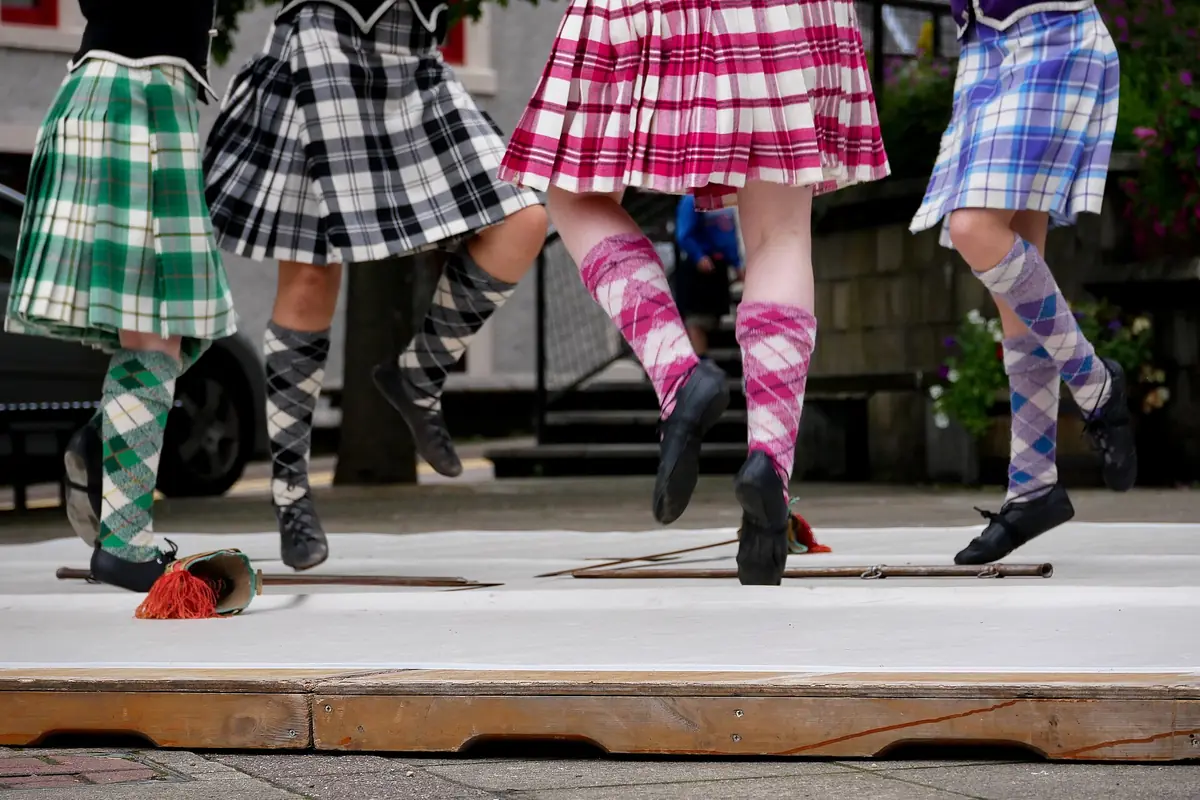
Highland dancing is a competitive solo style, which Wikipedia says is recognised as a sport by the Sport Council of Scotland. The article says modern Highland dancing emerged in the nineteenth and twentieth centuries, created from the Gaelic folk dance repertoire but formalised with the conventions of ballet. The Highland Fling and the Sword Dance are its best-known dances. In the Sword Dance, dancers step over two crossed swords laid on the floor. On the Inverness night this is the part you watch, before the ceilidh part begins.
Where Scottish country dancing sits
Scottish country dance is a third tradition, and Wikipedia describes it as a social dance for sets of couples who move through progressive patterns. Its steps include the skip-change of step and the pas de basque, where ceilidh dancing usually uses walking or running steps. The Royal Scottish Country Dance Society, which received royal patronage in 1947, trains most of its teachers. Several dances, among them the Gay Gordons and the Dashing White Sergeant, are shared between the country dance and ceilidh worlds.
Who this isn't for
Ceilidh dances are not for anyone who wants to learn polished technique in a single night. They are made for beginners, but they ask you to move with strangers, hold hands and keep going at speed. People with mobility needs should check the booking page and the venue before they book. And a guide cannot tell you which dances the Inverness band will play on your date, because that choice belongs to the musicians and whoever leads the floor.
Frequently asked questions
What dances are at a Scottish ceilidh?
Common ones include the Gay Gordons, the Dashing White Sergeant and Strip the Willow. The band and caller choose the order, so no night is guaranteed to include any one of them.
Is Strip the Willow hard?
It is a fast spinning dance, but the steps are walking and swinging. Wikipedia says the top couple spin and then swing each partner down the line, so most of the work is turning.
How many people dance the Dashing White Sergeant?
Groups of six, which split into two sets of three, Wikipedia says. The middle dancer of each set leads the figures with the partners on each side.
Sources